SAND – Flare Gun Colors Meaning and How to Change Them
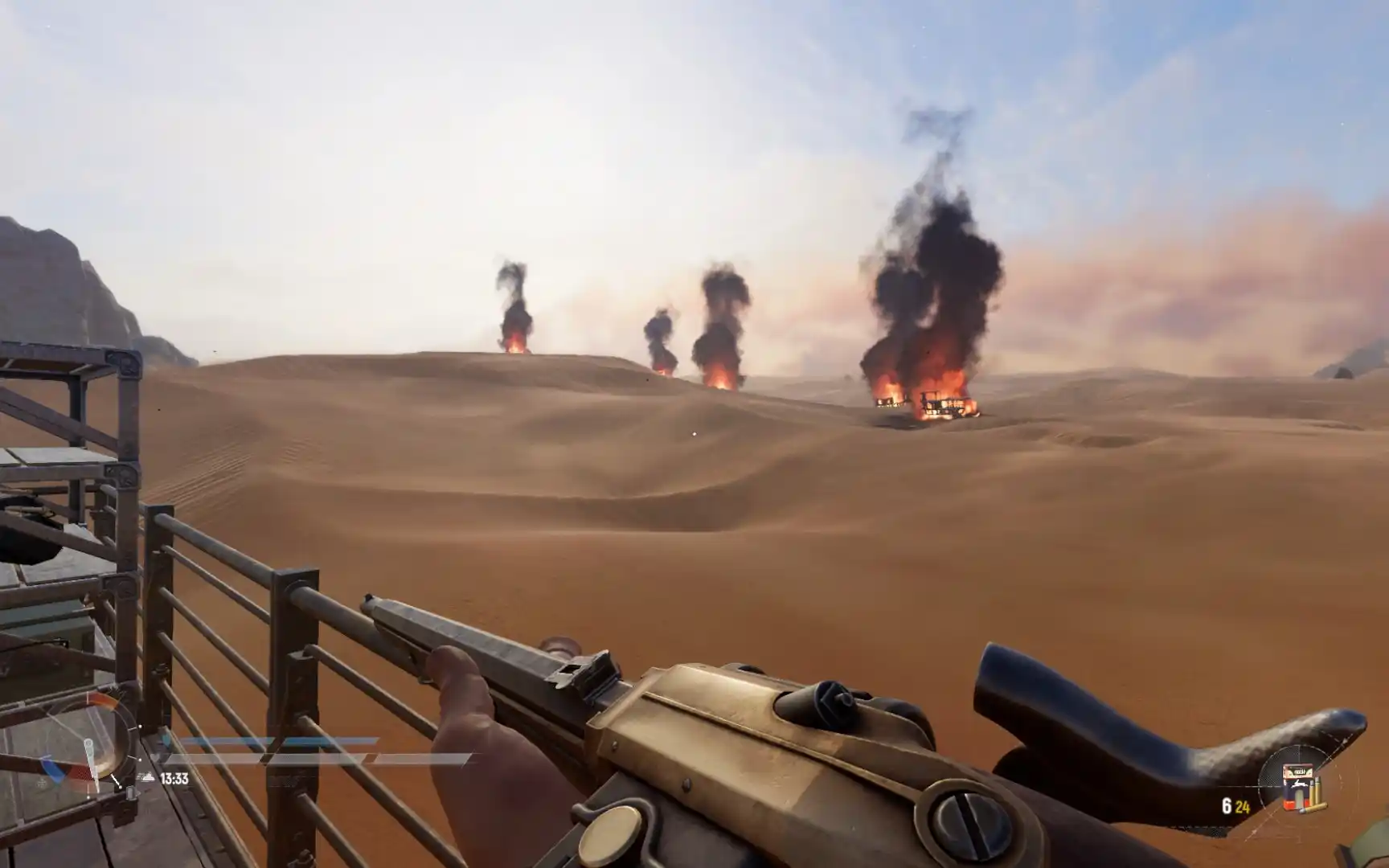
SAND’s flare gun is a communication tool only — it does no damage, has infinite ammo, and exists purely to signal other raiders. You can fire it in six colors: green (the default), red, yellow, cyan, orange, and dark blue. Hold R on PC (or hold Y / Triangle on a controller), use the scroll wheel to pick a color, release, then fire it upward — a shallow shot just arcs down without popping. The smoke cloud lasts about 45 seconds and is visible across the dunes. There is no official meaning to any color, but players have settled on a clear convention: green means friendly, red means hostile, and if you send green and get nothing back, assume a fight is coming.
How to change your flare color
The flare gun ships set to green. To switch:
- PC: hold R to open the color wheel, scroll up/down to the color you want, then release to load it.
- Controller: hold Y (Xbox) or Triangle (PlayStation) to bring up the same color switcher.
- Fire it into the sky, not at a flat angle, or it won’t explode into smoke.
The six available colors are green, red, yellow, cyan, orange, and dark blue. Flares have unlimited uses, but every shot reveals your position for roughly 45 seconds, so fire sparingly — a stray flare is a beacon that pulls hostile tramplers toward you.
One source of confusion worth clearing up: the bright green smoke that pours out of your trampler during extraction is not a flare. It triggers automatically when you start the ~90-second evacuation call at a radio tower, and it tells everyone nearby that you’re stationary and vulnerable. That’s a separate broadcast from the green flare you fire by choice to signal friendliness.
What each flare color means
There’s no built-in flare language in SAND, so meanings are entirely community-driven. Here’s where each color actually stands right now:
| Color | Common meaning | How settled it is |
|---|---|---|
| Green | Friendly, peaceful intent | Established — used game-wide |
| Red | Hostile, fight incoming | Established |
| Orange | Neutral but ready to fight | Player “code of honor” framing |
| Yellow / Cyan / Dark blue | No agreed meaning | Open — set your own with your crew |
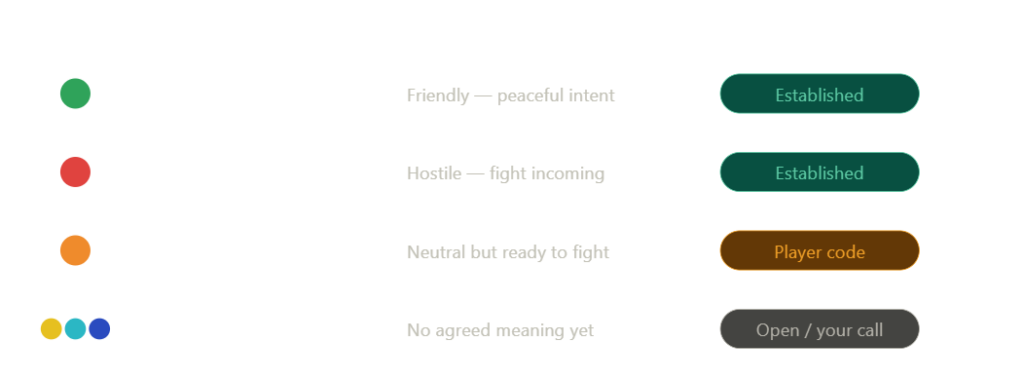
Green and red carry real weight because almost everyone reads them the same way. The other four are mostly a blank canvas — handy if you and your crew agree on private signals before a raid, but don’t expect a stranger to understand a cyan flare. If you’re coordinating with friends, settling on meanings beforehand is far more reliable than hoping a color reads the way you intend.
The unwritten etiquette — green flares and the trust problem
The most common exchange in SAND goes like this: an enemy trampler approaches, you fire a green flare, and you watch for their response. A matching green flare back usually signals they don’t intend to attack. No response is the universal cue to brace for a fight and position accordingly.
The catch: a green flare is a social signal, not a binding contract. Players absolutely bluff — there are plenty of accounts of someone flashing green, getting a green back, then opening fire anyway. So experienced raiders hedge while they “negotiate”: keep your trampler facing the other player head-on so you never expose your weak side armor to a broadside, scan the area with binoculars before trusting the lull, and never start repairs or drop your guard purely on the strength of a color in the sky. Treat green as “probably peace,” not “guaranteed safe.”
The Raider’s Code of Honor (community-made)
Beyond the basic green/red convention, an unofficial code of honor written by players has been circulating on SAND’s Steam guides (credited to community author Maroksik and collaborators). It’s worth knowing because a chunk of the playerbase has adopted it, and reading its signals correctly can keep you out of avoidable fights. To be clear, none of this is enforced by the game — it’s pure community etiquette, and you’re free to ignore it.
The gist of the code, in broad strokes:
- Answer a signal with a signal. If someone fires a flare at you, the polite move is to respond in kind rather than leave them guessing.
- Pause feuds when the AI shows up. Bots and desert monsters threaten everyone, so the convention is to stop fighting other players — and even help a struggling newcomer — until the common threat is cleared, then settle scores afterward.
- Don’t shoot a peaceful retreat. If a player is clearly disengaging and heading to extract, the etiquette is to let them go unless you were already in active combat with them, in which case the chase is fair.
- Rule-breakers get hunted. The community informally brands players who violate these norms (firing back after a peace signal, backstabbing during repairs) and encourages others to retaliate on sight.
You don’t have to follow any of it, but recognizing these behaviors in the wild helps you read intentions faster — and a red flare aimed your way from someone who was just signaling peace is a strong hint you’ve run into a “rat” the code is built to discourage.
When to use flares — and when to holster them
A flare is information you broadcast to the entire area, friend and foe alike. Use them when the upside is worth the exposure:
- Approaching another trampler: green to test for peace before committing to a fight.
- At an extraction zone: signal intent to a nearby player so you’re not both assuming the worst.
- Coordinating with your crew: pre-agreed colors for “regroup,” “danger,” or “I’m extracting.”
Avoid firing flares idly. Because the smoke lingers for ~45 seconds and carries across open dunes, an unnecessary flare is the fastest way to invite a fight you weren’t looking for.
Frequently asked questions
Do flares do damage in SAND? No. The flare gun is a communication tool only, with infinite ammo. Its sole purpose is signaling other players with colored smoke.
Does a green flare always mean it’s safe? No. Green is the community signal for “friendly,” and a matching green back usually means peaceful intent — but players can and do bluff, so stay positioned head-on and keep scanning.
Is there an official flare language in SAND? No. The game assigns no meaning to flare colors. Everything is community convention; green-friendly and red-hostile are the only two most players reliably understand.
Last updated: June 30, 2026 · By bilgisadak, gamesron — tracking SAND’s community signaling since the June 22 launch. The community code of honor referenced here is credited to its Steam-guide authors and is summarized, not reproduced.